


You don’t need a tutu, a dance history, or a childhood of Saturday morning classes. All you need is the willingness to begin.
If you’ve ever watched a ballet performance and thought “I wish I could do that” — this post is for you.
At Viv’Art Movement Academy in London, we welcome adult beginners every term, and what we see time and again surprises people: adults often make extraordinary dancers. Not in spite of starting later, but because of it. You bring focus, patience, and genuine desire — qualities that matter enormously in ballet.
Here’s everything you need to know before walking through our doors.
Why Adults Thrive in Ballet
There’s a persistent myth that ballet is only for those who started at age three. It’s simply not true.
Yes, professional ballet careers typically begin young. But recreational ballet — ballet for the love of movement, for fitness, for artistry, for the quiet satisfaction of doing something genuinely difficult — is available to anyone at any age.
Adult students bring a level of mindfulness and intentionality to class that often accelerates their learning. You understand your body differently at 30, 40, or 50 than you did as a child. That selfawareness is a real asset in ballet.
At Viv’Art, our adult beginner classes are designed specifically around where you are right now.
What to Expect in Your First Classes
The Barre: Every ballet class begins at the barre — the horizontal rail that runs along the studio wall. The barre is your best friend as a beginner. It gives you something to hold onto as you learn the foundational positions and exercises that underpin everything in ballet. In your first few classes, you’ll work through a series of exercises at the barre: pliés (bending the knees), tendus (stretching the foot along the floor), dégagés (brushing the foot off the floor), and relevés (rising onto the balls of your feet). These aren’t just warm-ups — they’re the vocabulary of ballet, and every professional dancer does them every single day.
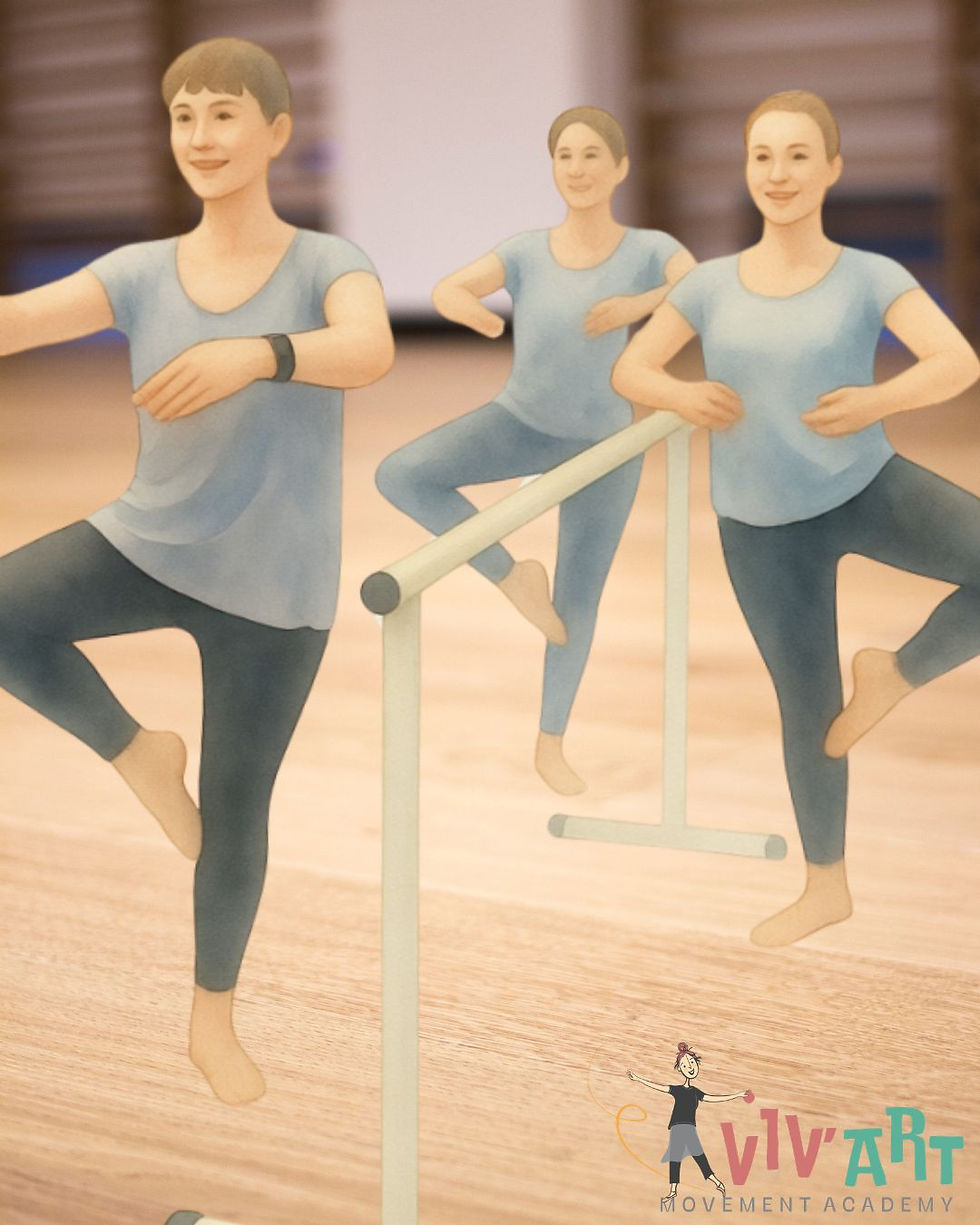
The Centre: After the barre, class moves to the centre of the studio, away from the rail. Here you’ll practice the same movements without support, plus simple combinations, turns, and eventually small travelling steps. The centre is where things get interesting — and where beginners often discover both their challenges and their strengths.
The Cool-Down: Classes typically close with stretching and adagio (slow, flowing) exercises. This is where ballet starts to feel like what you imagined — graceful, meditative, and deeply satisfying.
What to Wear
You don’t need to invest heavily before your first class.
Start simple:
• Leggings or fitted tracksuit bottoms — anything you can move freely in
• A fitted top — your teacher needs to see your posture
• Ballet shoes — these are worth getting early; they make a significant difference to how your feet move and how the floor feels. Canvas ballet flats are affordable and widely available.
A leotard is traditional but absolutely not required when you’re just starting.
Wear what makes you feel comfortable.
The Five Basic Positions
Before your first class, it helps to know that all of ballet is built on five positions of the feet (and corresponding arm positions).
You’ll learn these in your first session, but here’s a quick preview:
• First position — heels together, toes turned out
• Second position — feet apart, toes turned out
• Third position — one foot in front of the other, heel to arch
• Fourth position — feet apart front to back, toes turned out
• Fifth position — feet together, heel of front foot touching toe of back foot
Turnout (the outward rotation of the feet and legs) is fundamental to ballet, but it comes from the hips — never force it. Your natural turnout will develop gradually and safely over time.

Common Beginner Worries (And Why They Don’t Matter)
“I’m not flexible enough.” Flexibility develops with consistent practice. You don’t need it to begin — you’ll build it in class.
“I have no coordination.” Neither did every dancer before they started. Coordination is a skill, and ballet teaches it methodically, one step at a time.
“I’ll be the oldest/least experienced in the room.” Our adult beginner classes are full of people at exactly the same starting point. The atmosphere is supportive, not competitive.
“I’ll look ridiculous.” You’ll look like someone learning something new. That’s one of the best things a person can look like. The Benefits Beyond the Studio Students who come to Viv’Art for ballet often find that the benefits extend well beyond what they expected. Improved posture is almost universal — ballet demands alignment that carries into everyday life. Core strength, balance, and spatial awareness all develop steadily. Many students also speak about the mental clarity that comes from an hour completely focused on something physical and precise; in a busy London life, that can feel like a rare gift. How to Get Started at Viv’Art Our adult beginner ballet classes run throughout the term, and new students are welcome to join at anytime. Classes are kept small to ensure individual attention, and our teachers are experienced in working with adult learners at every stage. Whether you’ve never worn ballet shoes or you danced a little as a child and want to return to it, there’s a place for you at Viv’Art Movement Academy. Ready to take your first step? Get in touch or book your spot. We’d love to see you at the barre. Viv’Art Movement Academy | London | info@vivartmovementacademy.com